The Ridley Rabbit Hole: Snake Dance
By The Tiger Times Head Archivist Ms. Kelly Neill ‘81
Join us as we tumble down into the Ridley Rabbit Hole and share facts and stories from the Archives. Questions? Feel free to email kelly_neill@ridleycollege.com
As the night sky veils the campus in darkness, a pulsating, tribal beat echoes across A- Squad, beckoning Ridleians to rally and prepare for “SNAKE DANCE”. The name alone conjures up mystical or voodoo-like imagery that is difficult to translate to an outsider and over time has transformed from a pagan sensation to what might be best described as a tradition or rite of passage that every Ridleian must experience.
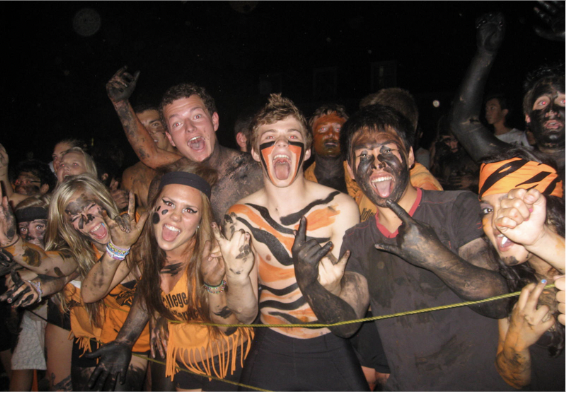
Our history books first mention a “Snake Race” on campus in 1919 and again in 1937 as part of the annual gymnastics display programme. The term to “snake, slither, lurk or twist’ became a common descriptive term during the First World War and suggested a military tactic to daze and confuse the enemy. The first official mention of a “Snake Dance” appears in the 1942 ACTA (during the height of the Second World War) and suggests that the event included a school -wide gathering of senior boys who formed a massive single human chain that would run from the Upper School, snaking their way from house to house and eventually landing at the LS courtyard to join up with the Lower School students who most likely watched in fear from the dorm rooms that overlooked the space. The students would wear ragged clothing and paint their faces with black shoe polish, and the rhythmic sound of a drum or bugle would set the frantic pace that fired their spirit. Short skits or plays were performed by candlelight and often included the presentation of an effigy or stuffed dummy wearing the jersey of a visiting football team. The boys would perform an “intricate autopsy” and victoriously pronounce the effigy or enemy as lifeless and defeated. It would be most fair to say that the boys found a moment to vent their fear and frustration of a war that was being fought on the other side of the ocean and their tribal, cult-like behavior fueled passion, school spirit and victory on the playing fields and front lines.
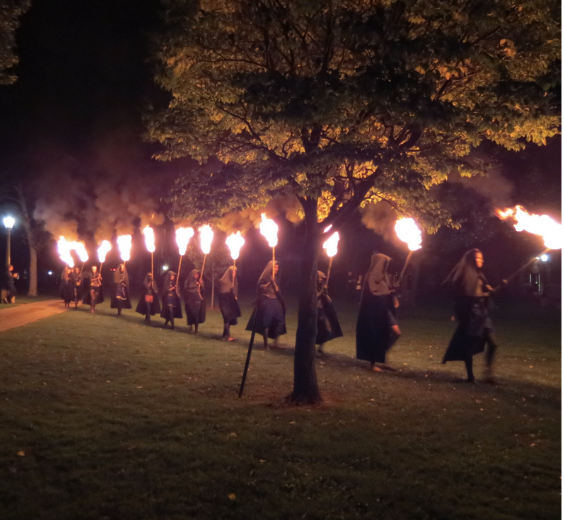
In the years that followed, Snake Dance would continue to thrive as Ridley dominated as champions on and off the fields and courts. Typically, the event was held in mid-October at the height of football season and as a kick-off to Homecoming Weekend. Torches made of old hockey sticks with kerosene-soaked rags were dangerously lit and team captains and players led the way to a blazing bonfire and much like the symbolism in William Goldings’ Lord of the Flies, the fire burned as a symbol of our hope, spirit and desire. Yes, it is true. The unfortunate effigy of the opposing team would be cast into the flames in hopes that a spell was cast in favour of our victory. The fire would eventually burn down but the visceral effect of the evening’s chants, skits, cheers and songs would energize the students for the months ahead.
The 60s and 70s offered up a milder approach to Snake Dance. The unsavoury skits had gone by the wayside and the Lower School no longer participated in the late-night fervor. The students continued to paint themselves in orange and black and creative costumes and the introduction of boom box music blared across the campus and three official cheer leaders (wearing emblazoned sweaters with a B, R and C) would lead the school in songs and cheers. The spirit still burned brightly and so did the fire.
During the 80s, Snake Dance underwent careful consideration, in light of the fact that girls were now part of the mix and on one occasion the Fire Department arrived because of neighbourhood complaints. Leadership was challenged by the safety concerns and whether it was suitable to carry on with a spectacle that was born out of an Old Boy System and had evolved from what seemed a “wild, tribal” dance into a spirited night that was steeped in tradition and still breathed fire within the hearts of each Ridleian that had gone on before.
Outsiders might describe this annual tradition as mysterious, magic, and even mayhem, but to a Ridleian it is one of our oldest traditions, a rite of passage and a shared fire that burns bright within each of us. Times have changed and Snake Dance has understandably evolved with the introduction of pulsating electronic music, fireworks and a more “controlled” approach around a blazing bonfire. We are undeniably a school whose sense of community, passion and spirit is drenched in Orange and Black and hopefully Snake Dance will continue to be an evening that allows us for a moment to be transformed, consumed and spiritually connected as a “Tyger, Tyger burning bright” (Poet, William Blake, 1793).
Image(s) Credits: Kelly Neill,